

Recyclable Thermoset Resins Market Outlook: Price Trends, Production Capacity and Demand Forecast (2026–2036)
Rising pressure from circular economy mandates and composite waste challenges accelerates adoption of reversible polymer technologies
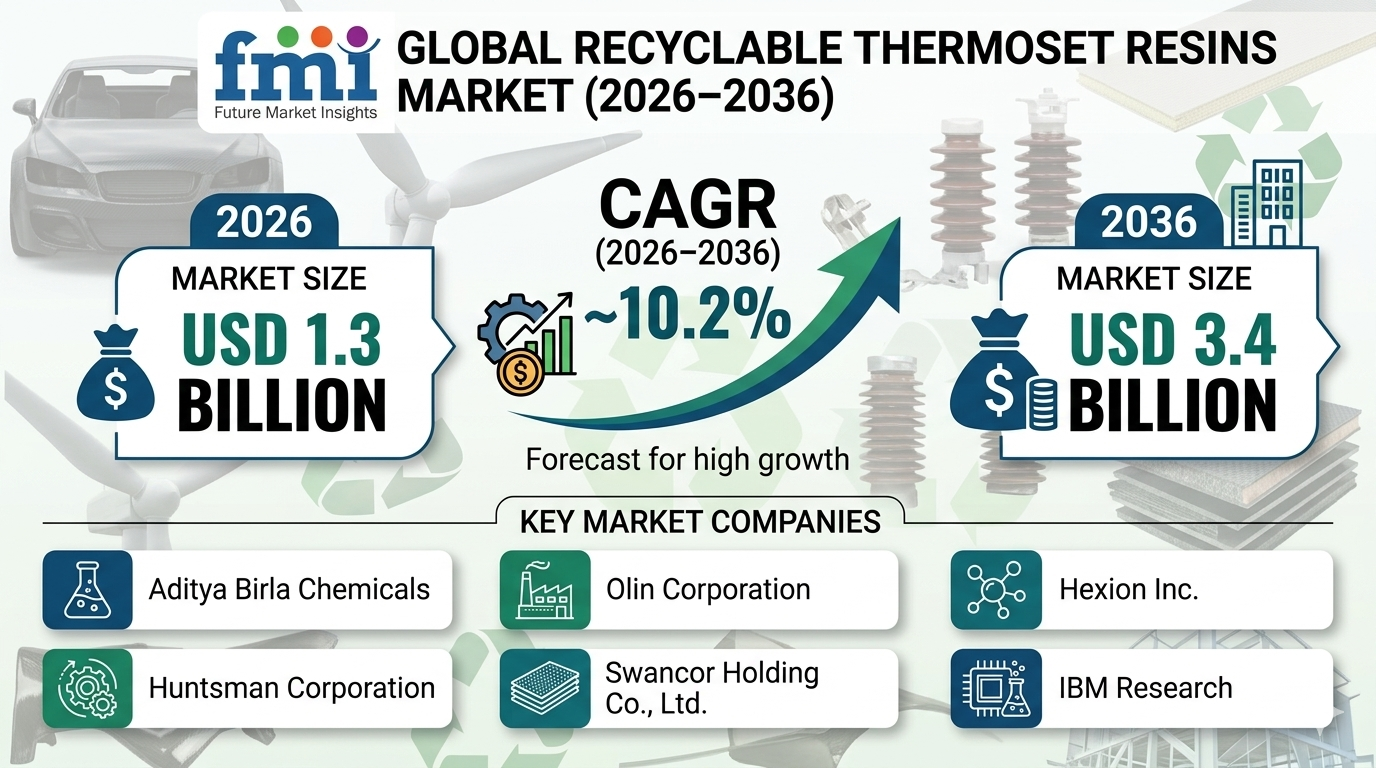
NEWARK, DE, UNITED STATES, March 20, 2026 /EINPresswire.com/ -- The global Recyclable Thermoset Resins Market, valued at over USD 1.2 billion in 2025, is estimated to reach USD 1.3 billion in 2026 and is projected to expand to USD 3.4 billion by 2036, growing at a CAGR of 10.2% during the forecast period. Growth is primarily driven by regulatory pressure on composite waste disposal, increasing adoption in wind energy and automotive sectors, and the urgent need to transition from linear to circular material systems.
As industries confront the mounting challenge of end-of-life composite waste—particularly from wind turbine blades and aerospace structures—recyclable thermoset resins are emerging as a critical solution. These advanced materials enable depolymerization and recovery of high-value fibers, shifting thermosets from permanent materials to circular assets within industrial ecosystems.
Recyclable Thermoset Resins Market Snapshot (2026–2036)
• Market size in 2026: USD 1.3 billion
• Market size in 2036: USD 3.4 billion
• CAGR (2026–2036): ~10.2%
• Leading resin type: Epoxy-based recyclable thermosets
• Top end-use segment: Wind energy
• Dominant recycling method: Chemical recycling
• Fastest-growing country: India
• Key players: Global specialty chemical and advanced materials companies
Market Momentum
The market enters 2026 with strong institutional backing, supported by regulatory frameworks such as extended producer responsibility (EPR) and end-of-life vehicle directives. Between 2028 and 2032, the industry witnesses accelerated qualification of reversible resin systems, particularly in wind turbine manufacturing and automotive lightweighting.
By 2036, widespread deployment of chemical recycling infrastructure and closed-loop material systems enables recyclable thermosets to become standard in high-performance composite applications. The market’s growth is reinforced by increasing alignment between material science innovation and reverse logistics capabilities.
Request For Sample Report | Customize Report |purchase Full Report - https://www.futuremarketinsights.com/reports/sample/rep-gb-32288
Why the Market is Growing
The Recyclable Thermoset Resins Market is expanding due to a structural shift in how industries evaluate material lifecycle costs. Traditional thermosets, once favored for their durability, now pose significant financial and environmental liabilities due to landfill restrictions and disposal costs.
Recyclable thermosets address this challenge by incorporating reversible cross-linking chemistries, allowing composites to be broken down and reused. This capability is especially critical in wind energy, where decommissioned blades create large-scale waste management issues.
Additionally, procurement strategies are evolving. Manufacturers are increasingly factoring end-of-life recovery into material selection, prioritizing resins that offer both performance and recyclability. This shift transforms recyclable thermosets from niche innovations into strategic materials.
Segment Spotlight
1. Resin Type: Epoxy Leads with Structural Dominance
Epoxy-based recyclable thermosets account for approximately 45.2% of the market in 2026. Their high mechanical strength and suitability for load-bearing applications make them essential in aerospace, wind, and automotive sectors.
2. Recycling Technology: Chemical Recycling Takes the Lead
Chemical recycling holds a projected 52.4% share, as it enables recovery of continuous fibers without compromising structural integrity. This method is critical for maintaining the value of carbon and glass fiber composites.
3. End Use: Wind Energy Drives Demand
Wind energy represents around 38.7% of total demand, driven by the increasing volume of turbine blade decommissioning and regulatory scrutiny over disposal practices.
Drivers, Opportunities, Trends, Challenges
• Drivers: Regulatory mandates, composite waste crisis, lifecycle cost optimization
• Opportunities: Closed-loop recycling systems, secondary markets for recovered materials, infrastructure development
• Trends: Qualification-driven procurement, integration of circularity into design, rise of dynamic covalent chemistry
• Challenges: Lack of reverse logistics infrastructure, high initial qualification costs, scalability of chemical recycling
Country Growth Outlook (2026–2036)
India leads global growth with a CAGR of 13.4%, supported by rapid expansion in renewable energy and early adoption of circular manufacturing practices. China follows at 12.5%, driven by large-scale industrial production and state-backed sustainability initiatives.
Germany (11.2%), the United Kingdom (10.5%), and France (10.1%) show strong growth due to stringent environmental regulations. Japan (9.1%) and the United States (8.4%) maintain steady expansion, supported by advanced manufacturing ecosystems and innovation in material science.
Competitive Landscape
The market is characterized by a high concentration of specialized chemical companies with advanced formulation capabilities. Leading players focus on developing dynamic covalent networks, optimizing depolymerization processes, and establishing closed-loop material ecosystems.
Competition is increasingly centered on lifecycle integration—offering not just recyclable resins, but complete recovery solutions. Companies that can align material innovation with scalable recycling infrastructure and OEM partnerships are expected to secure long-term market leadership.
Frequently Asked Questions (FAQ)
What is the global Recyclable Thermoset Resins Market size?
The market is valued at approximately USD 1.3 billion in 2026 and is projected to reach USD 3.4 billion by 2036.
What is the expected growth rate?
The market is forecast to grow at a CAGR of around 10.2% from 2026 to 2036.
What are recyclable thermoset resins?
They are advanced polymer materials with reversible cross-links that allow composites to be broken down and recycled at end-of-life.
Why are these resins gaining importance?
They help reduce environmental impact, recover valuable materials, and comply with increasingly strict disposal regulations—while maintaining high-performance standards.
Explore More Related Studies Published by FMI Research:
UV-Resistant Masterbatches Market https://www.futuremarketinsights.com/reports/uv-resistant-masterbatches-market
Busbar Potting Compounds Market https://www.futuremarketinsights.com/reports/busbar-potting-compounds-market
Busbar Insulation Films Market https://www.futuremarketinsights.com/reports/busbar-insulation-films-market
About Future Market Insights (FMI)
Fture Market Insights, Inc. (FMI) is an ESOMAR-certified, ISO 9001:2015 market research and consulting organization, trusted by Fortune 500 clients and global enterprises. With operations in the U.S., UK, India, and Dubai, FMI provides data-backed insights and strategic intelligence across 30+ industries and 1200 markets worldwide.
Why Choose FMI: https://www.futuremarketinsights.com/why-fmi
Sudip Saha
Future Market Insights Inc.
+1 347-918-3531
rahul.singh@futuremarketinsights.com
Legal Disclaimer:
EIN Presswire provides this news content "as is" without warranty of any kind. We do not accept any responsibility or liability for the accuracy, content, images, videos, licenses, completeness, legality, or reliability of the information contained in this article. If you have any complaints or copyright issues related to this article, kindly contact the author above.
