

Event Management Software Market to Hit USD 96.5 Billion by 2036, Asia Pacific Leads with Cvent, Eventbrite & Bizzabo
Event Management Software Market
Rising hybrid events and cloud adoption drive the market to USD 96.5Billion by 2036, as enterprises shift to AI-powered event platforms for scale.
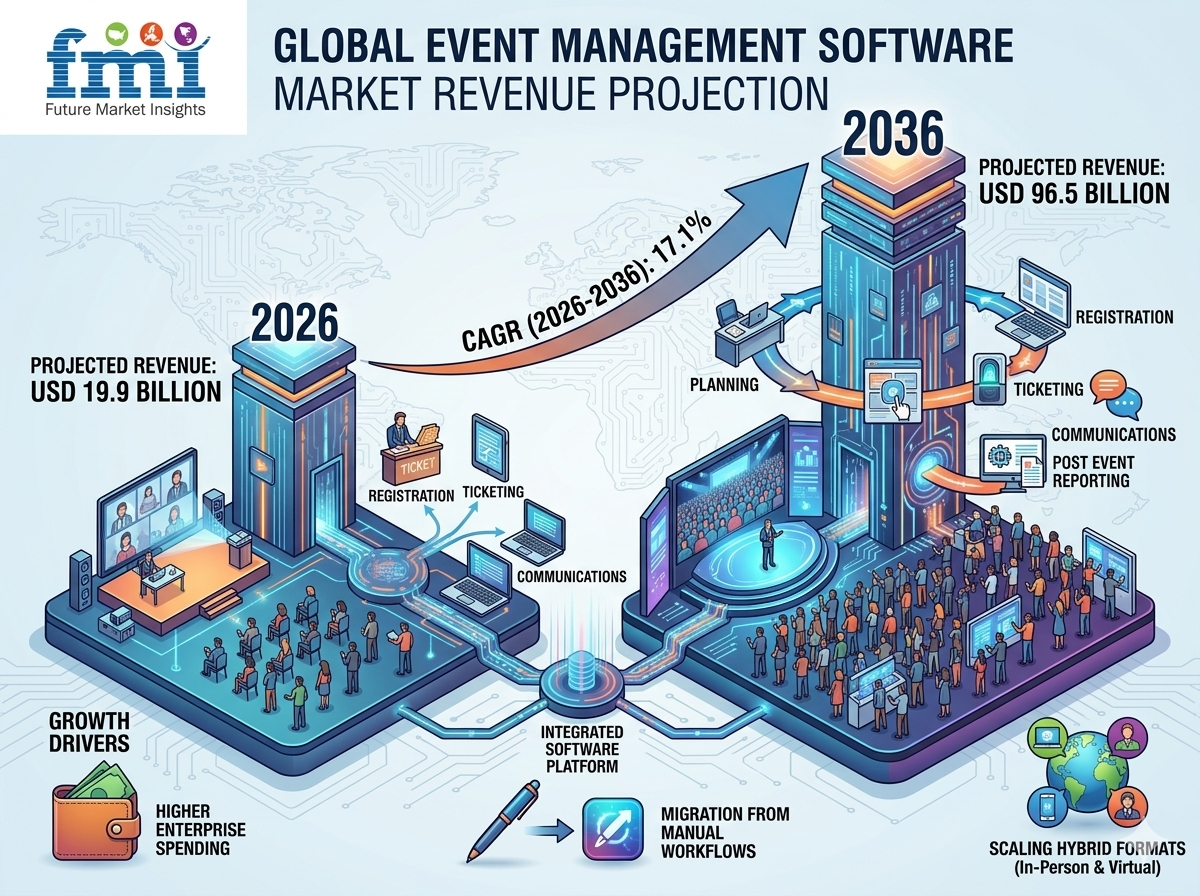
NEWARK, DE, UNITED STATES, March 30, 2026 /EINPresswire.com/ -- The global Event Management Software Market is valued at USD 19.9 billion in 2026 and is projected to reach USD 96.5 billion by 2036, expanding at a CAGR of 17.1% from 2026 to 2036. Growth is driven by increasing enterprise spending on event programs, rapid transition from manual workflows to integrated platforms, and the rising adoption of hybrid event models combining virtual and in-person experiences.
As organizations seek scalable and data-driven event solutions, event management software is evolving from basic registration tools into comprehensive platforms that integrate planning, attendee engagement, analytics, and post-event reporting. This transformation positions the market as a critical enabler of digital business communication strategies.
Grab Your Complimentary Sample — Access the Report Today!
https://www.futuremarketinsights.com/reports/sample/rep-gb-1849
Event Management Software Market Snapshot (2026–2036)
• Market size in 2026: USD 19.9 billion
• Market size in 2036: USD 96.5 billion
• CAGR (2026–2036): ~17.1%
• Leading segment: Cloud-based deployment
• Top end-use segment: Large enterprises
• Dominant user group: Event management companies
• Fastest-growing country: India
• Key companies: Cvent Inc., Eventbrite, Bizzabo, Aventri Inc., Hubilo Technologies Inc.
Market Momentum
The event management software market begins at USD 19.9 billion in 2026, supported by growing demand for integrated digital event platforms and enterprise-level workflow automation. Between 2027 and 2030, increasing adoption of hybrid event formats and cloud-native architectures accelerates deployment across global organizations.
By 2032, advancements in artificial intelligence, behavioral analytics, and mobile-first event applications further enhance attendee engagement and operational efficiency. Expansion of API-driven integrations with CRM, marketing automation, and analytics tools strengthens enterprise adoption.
By 2036, the market reaches USD 96.5 billion, driven by widespread digitization of event ecosystems across industries including corporate, government, academic, and hospitality sectors.
Why the Market is Growing
The Event Management Software Market is expanding rapidly as organizations prioritize efficiency, scalability, and data-driven decision-making in event execution. Traditional manual processes are being replaced by unified platforms that streamline planning, registration, communication, and analytics.
Cloud-based deployment models are gaining strong traction due to their ability to support real-time scalability, global accessibility, and seamless integration with enterprise systems. These platforms reduce IT infrastructure burden while enabling faster rollout across geographically distributed teams.
Additionally, hybrid event formats are redefining industry standards, requiring software solutions that can manage both physical and virtual environments within a single workflow. This dual capability significantly enhances audience reach and engagement.
Technological advancements such as artificial intelligence, machine learning, and blockchain-enabled ticketing are further strengthening platform capabilities. AI-driven insights enable personalized attendee experiences, while blockchain improves security and transparency in event transactions.
Segment Spotlight
1. Deployment: Cloud-Based Solutions Lead
Cloud-based deployment accounts for approximately 55.2% of the market share in 2026, driven by scalability, reduced infrastructure costs, and faster implementation across regions.
2. Enterprise Type: Large Enterprises Dominate
Large enterprises contribute around 61.5% of demand, supported by higher event volumes, complex stakeholder environments, and strong need for integration, governance, and analytics.
3. End Use: Event Management Companies Hold Strong Share
Event management companies represent nearly 32.8% of the market, leveraging software platforms for multi-client operations, workflow optimization, and consistent service delivery.
Drivers, Opportunities, Trends, Challenges
Drivers:
• Shift from manual workflows to integrated platforms
• Growing adoption of hybrid and virtual events
• Rising enterprise demand for analytics and automation
Opportunities:
• AI-powered event personalization and automation
• Expansion in emerging markets
• Integration with enterprise software ecosystems
Trends:
• Rise of cloud-native and SaaS-based platforms
• Increasing use of mobile-first event applications
• Adoption of blockchain for secure ticketing
Challenges:
• Data privacy and compliance requirements
• High competition and platform differentiation
• Integration complexity with legacy systems
Country Growth Outlook (2026–2036)
India leads the market with a CAGR of 18.3%, driven by rapid digital transformation and expanding startup ecosystems. China follows at 17.6%, supported by strong technology adoption and corporate infrastructure investments.
Brazil records a CAGR of 16.8%, reflecting growing enterprise spending on digital tools, while the USA (16.2%) maintains steady growth due to advanced technology adoption and hybrid work models. Germany (15.4%) continues to expand with a focus on compliance-driven software solutions and enterprise efficiency.
Competitive Landscape
The event management software market is highly competitive, with vendors focusing on innovation, user experience, and enterprise integration capabilities. Companies such as Cvent Inc., Eventbrite, and Bizzabo are investing in AI-driven features, automation tools, and enhanced analytics to differentiate their offerings.
Competition is shifting toward delivering end-to-end event ecosystems that integrate CRM systems, marketing platforms, payment gateways, and collaboration tools. Strategic partnerships and acquisitions are also playing a critical role in expanding capabilities and accelerating product development.
Vendors are increasingly prioritizing workflow automation, personalization, and real-time analytics to meet evolving enterprise demands. Sustainability and data security are emerging as additional competitive factors influencing buyer decisions.
Frequently Asked Questions (FAQ)
What is the global Event Management Software Market size?
The market is valued at USD 19.9 billion in 2026 and is projected to reach USD 96.5 billion by 2036.
At what rate is the market expected to grow?
The market is expected to expand at a CAGR of approximately 17.1% from 2026 to 2036.
What is event management software?
It is a digital platform that helps organizations manage event planning, registration, communication, engagement, and analytics in a unified system.
Why is event management software gaining popularity?
It improves operational efficiency, enables hybrid event execution, and provides data-driven insights for better decision-making.
Explore More Related Studies Published by FMI Research:
Mobile Application Market - https://www.futuremarketinsights.com/reports/global-mobile-application-market
Video Game Market - https://www.futuremarketinsights.com/reports/video-game-market
Parking Management Market - https://www.futuremarketinsights.com/reports/parking-management-market
About Future Market Insights (FMI)
Future Market Insights, Inc. (FMI) is an ESOMAR-certified and ISO 9001:2015 market research and consulting organization, trusted by Fortune 500 companies and global enterprises. With a strong global presence across the U.S., UK, India, and Dubai, FMI delivers data-driven insights and strategic intelligence across diverse industries and markets.
Why Choose FMI:
https://www.futuremarketinsights.com/why-fmi
Sudip Saha
Future Market Insights Inc.
+1 347-918-3531
rahul.singh@futuremarketinsights.com
Legal Disclaimer:
EIN Presswire provides this news content "as is" without warranty of any kind. We do not accept any responsibility or liability for the accuracy, content, images, videos, licenses, completeness, legality, or reliability of the information contained in this article. If you have any complaints or copyright issues related to this article, kindly contact the author above.
