

Organophosphate Insecticides Market Intelligence Report: Price Forecast and Growth Drivers (2026–2036)
Growing agricultural pest control needs and vector management programs sustain global demand despite regulatory divergence
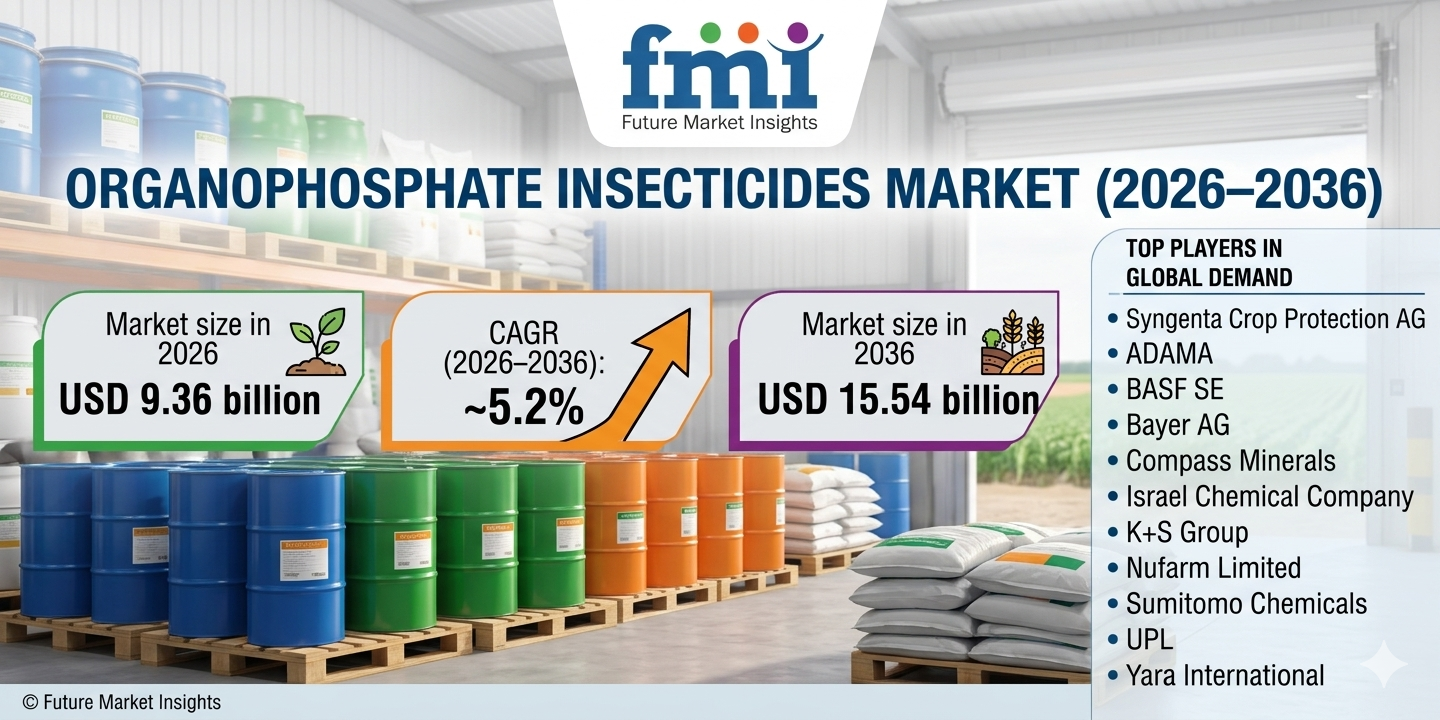
NEWARK, DE, UNITED STATES, April 1, 2026 /EINPresswire.com/ -- The global Organophosphate Insecticides Market is valued at USD 9.36 billion in 2026 and is projected to reach USD 15.54 billion by 2036, expanding at a CAGR of 5.2% from 2026 to 2036. Growth is driven by sustained agricultural demand in developing regions, increasing pest resistance to alternative chemistries, and continued reliance on cost-effective broad-spectrum insecticides across large-scale farming systems.
As crop protection strategies evolve, organophosphate insecticides are transitioning from legacy chemistries into strategically deployed solutions within integrated pest management (IPM) frameworks—ensuring their continued relevance in global agriculture and public health applications.
Organophosphate Insecticides Market Snapshot (2026–2036)
• Market size in 2026: USD 9.36 billion
• Market size in 2036: USD 15.54 billion
• CAGR (2026–2036): ~5.2%
• Leading active ingredient: Chlorpyrifos
• Top application segment: Agricultural crop protection
• Key demand regions: Asia-Pacific and Latin America
• Fastest-growing country: China
• Key companies: Global agrochemical manufacturers and distributors
Market Momentum
The Organophosphate Insecticides Market is entering 2026 with strong baseline demand from agricultural economies where pest pressure remains high and cost sensitivity influences purchasing decisions. Between 2026 and 2030, demand is expected to expand steadily due to increased cultivation intensity and rising incidences of pest resistance to pyrethroids and neonicotinoids.
From 2030 onward, growth will be reinforced by advancements in formulation technologies such as microencapsulation and controlled-release delivery systems, which improve safety and environmental performance. By 2036, the market will reach USD 15.54 billion, supported by its integration into rotational pest management strategies and public health vector control programs.
Request For Sample Report | Customize Report |purchase Full Report - https://www.futuremarketinsights.com/reports/sample/rep-gb-23028
Why the Market is Growing
The Organophosphate Insecticides Market is expanding due to the continued need for effective, broad-spectrum pest control solutions in agriculture. Farmers in regions such as India, China, Brazil, and Southeast Asia rely on these insecticides to manage pests like bollworms, stem borers, and aphids, which threaten crop yields and food security.
In addition, public health initiatives aimed at controlling mosquito-borne diseases such as malaria and dengue are sustaining demand for organophosphate-based solutions like malathion and temephos. These applications provide a stable, non-agricultural demand base independent of crop cycles.
Another critical driver is resistance management. Organophosphates are increasingly used in rotation with other insecticide classes to delay resistance development, extending their commercial lifecycle and ensuring continued utility in integrated pest management programs.
Segment Spotlight
1. Application: Agricultural Segment Leads Demand
Agricultural applications account for approximately 72.3% of total demand, driven by the need to protect high-value crops across cereals, fruits, vegetables, and cotton. Their rapid knockdown effect and cost efficiency make them indispensable in large-scale farming.
2. Active Ingredient: Chlorpyrifos Dominates Market Share
Chlorpyrifos holds around 35.7% of the market share in 2026, supported by its broad-spectrum efficacy, established distribution networks, and widespread familiarity among farmers and agronomists.
3. Use Case: Integrated Pest Management Expands Adoption
IPM programs are reinforcing organophosphate usage as rotational tools, allowing farmers to manage resistance while maintaining effective pest control across multiple crop cycles.
Drivers, Opportunities, Trends, Challenges
• Drivers: Rising crop protection demand, pest resistance management, public health vector control
• Opportunities: Advanced formulations, emerging market expansion, hybrid insecticide solutions
• Trends: Microencapsulation technologies, dual-mode insecticides, regulatory-driven innovation
• Challenges: Environmental concerns, regulatory restrictions in developed markets, safety compliance costs
Country Growth Outlook (2026–2036)
China leads the market with a projected CAGR of 7.0%, driven by strong domestic production and export capabilities. India follows at 6.5%, supported by extensive agricultural use and expanding agrochemical distribution networks. Germany and France show moderate growth due to controlled usage under regulatory frameworks, while the United States and the United Kingdom maintain steady demand influenced by regulatory scrutiny and targeted application practices. Brazil continues to play a key role with stable demand from soybean, sugarcane, and cotton farming.
Competitive Landscape
The market is characterized by a mix of multinational agrochemical companies and regional manufacturers competing on formulation innovation, cost efficiency, and distribution reach. Key players are investing in safer and more efficient delivery systems to address regulatory concerns while maintaining product effectiveness.
Competition increasingly focuses on balancing efficacy with environmental compliance, improving product safety profiles, and expanding presence in high-growth agricultural markets. Strategic collaborations with governments and agricultural organizations are also shaping market dynamics, particularly in vector control and resistance management initiatives.
Frequently Asked Questions (FAQ)
What is the global Organophosphate Insecticides Market size?
The market is valued at approximately USD 9.36 billion in 2026 and is projected to reach USD 15.54 billion by 2036.
At what rate is the market expected to grow?
The market is forecast to expand at a CAGR of about 5.2% from 2026 to 2036.
What are organophosphate insecticides?
They are acetylcholinesterase-inhibiting pesticides derived from phosphoric acid esters, used for controlling a wide range of insect pests in agriculture and public health applications.
Why are organophosphate insecticides still widely used?
They offer cost-effective, broad-spectrum pest control and play a critical role in resistance management and vector control programs, particularly in developing regions.
Explore More Related Studies Published by FMI Research:
In-Season Foliar Nitrogen Fine-Tuning Blend Market https://www.futuremarketinsights.com/reports/in-season-foliar-nitrogen-fine-tuning-blend-market
High-Cation-Exchange-Capacity Enhancing Fertility Blend Market https://www.futuremarketinsights.com/reports/high-cation-exchange-capacity-enhancing-fertility-blend-market
Biochar-Integrated Granular Fertility Blend Market: https://www.futuremarketinsights.com/reports/biochar-integrated-granular-fertility-blend-market
About Future Market Insights (FMI)
Fture Market Insights, Inc. (FMI) is an ESOMAR-certified, ISO 9001:2015 market research and consulting organization, trusted by Fortune 500 clients and global enterprises. With operations in the U.S., UK, India, and Dubai, FMI provides data-backed insights and strategic intelligence across 30+ industries and 1200 markets worldwide.
Why Choose FMI: https://www.futuremarketinsights.com/why-fmi
Sudip Saha
Future Market Insights Inc.
+1 347-918-3531
rahul.singh@futuremarketinsights.com
Legal Disclaimer:
EIN Presswire provides this news content "as is" without warranty of any kind. We do not accept any responsibility or liability for the accuracy, content, images, videos, licenses, completeness, legality, or reliability of the information contained in this article. If you have any complaints or copyright issues related to this article, kindly contact the author above.
