

Global Sustainable Plastic Packaging Market Outlook: Asia-Pacific Leads Regulatory Shift with Amcor, Mondi & Berry
Sustainable Plastic Packaging Market
Anti-Soiling Aircraft Exterior Coatings Market Size and Share Forecast Outlook 2026 to 2036
ROCKVILLE, MD, UNITED STATES, April 8, 2026 /EINPresswire.com/ -- According to Fact MR, latest analysis The global sustainable plastic packaging market has transitioned from a voluntary sustainability initiative into a compliance-driven, regulation-backed industry, reshaping how packaging is designed, sourced, and recycled.Valued at USD 113.2 billion in 2026, the market is projected to reach USD 119.5 billion in 2027 and expand to approximately USD 194.5 billion by 2036, registering a CAGR of 5.6%. The market is expected to generate an incremental opportunity of over USD 81 billion during the forecast period.This transformation is driven by Extended Producer Responsibility (EPR) laws, plastic taxes, and mandatory recycled content requirements, compelling global brands to redesign packaging formats toward recyclability and circularity.
Get detailed market forecasts, competitive benchmarking, and pricing trends: https://www.factmr.com/connectus/sample?flag=S&rep_id=14476
Quick Stats
Market Size (2026): USD 113.2 Billion
Market Size (2027): USD 119.5 Billion
Forecast Value (2036): USD 194.5 Billion
CAGR (2026–2036): 5.6%
Incremental Opportunity: USD 81+ Billion
Leading Segment: Flexible Packaging (66%)
Leading Packaging Type: Primary Packaging (54%)
Leading Region: Asia-Pacific
Key Players: Amcor plc, Mondi Group, Berry Global, WestRock Company, Tetra Laval
Executive Insight for Decision Makers
The market is shifting from cost-driven packaging to compliance-driven, sustainability-led innovation.
Strategic Shift:
Packaging is no longer a cost center but a regulatory and brand differentiation lever, driven by recyclability and carbon footprint reduction.
What Industry Leaders Must Do:
Invest in mono-material recyclable packaging platforms
Secure recycled resin supply chains
Align with multi-region regulatory compliance frameworks
Risk of Inaction:
Companies risk regulatory penalties, product delisting by retailers, and brand reputation loss if sustainability compliance is not achieved.
Market Dynamics
Key Growth Drivers
Implementation of EPR laws and plastic taxes globally
Rising demand for recyclable and recycled content packaging
Sustainability commitments from FMCG and e-commerce companies
Expansion of global recycling infrastructure and policies
Key Restraints
Higher cost of sustainable packaging (15–35% premium)
Limited availability of high-quality recycled plastics
Complexity in meeting multi-region compliance standards
Emerging Trends
Rapid shift toward mono-material flexible packaging
Growth in certified recyclable and compostable packaging
Increasing adoption of recycled content in primary packaging
Expansion of sustainable packaging in e-commerce logistics
Segment Analysis
Leading Segment:
Flexible packaging dominates with 66% share, driven by cost efficiency and recyclability advancements.
Fastest-Growing Segment:
Recyclable mono-material films and bio-based packaging solutions.
By Packaging Type:
Primary packaging leads with 54% share
Secondary and tertiary packaging gaining traction in retail logistics
By End-Use:
Food & beverage remains the dominant sector
Personal care and e-commerce show rapid adoption
Strategic Insight:
Flexible packaging is emerging as the core innovation platform for sustainability transformation.
Supply Chain Analysis (Critical Insight)
Value Chain Structure
Raw Material Suppliers
Petrochemical companies producing recycled and bio-based resins
Packaging Manufacturers
Flexible and rigid packaging converters
Brand Owners (FMCG/E-commerce)
Companies specifying sustainable packaging requirements
Distributors & Retailers
Retail chains enforcing sustainability compliance
End-Users
Consumers driving demand for eco-friendly packaging
Who Supplies Whom
Resin producers → packaging converters
Converters → FMCG brands and retailers
Brands → retailers and e-commerce platforms
Key Insight:
Control over recycled resin supply and certification is becoming a key competitive advantage.
Pricing Trends
Commodity vs Premium:
Conventional plastics → low-cost, high-volume
Sustainable plastics → premium pricing due to compliance and certification
Key Pricing Drivers:
Cost of recycled content and bio-based materials
Regulatory compliance costs
Certification and traceability requirements
Margin Insight:
Suppliers with certified sustainable solutions maintain stronger margins despite higher production costs.
Regional Analysis
Top Countries by CAGR (2026–2036)
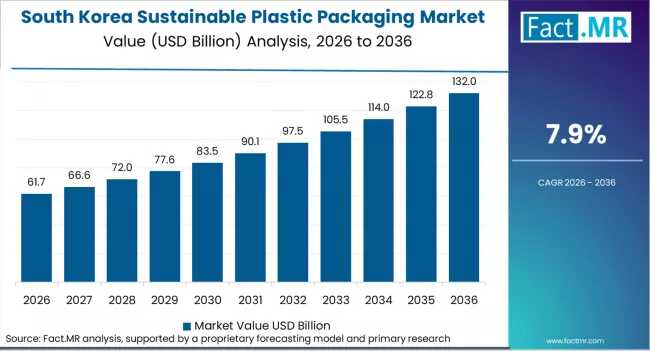
South Korea: 7.9% – Strong EPR enforcement
Japan: 7.3% – Regulatory compliance and innovation
China: 7.0% – Large-scale e-commerce demand
United States: 6.7% – State-level regulatory expansion
United Kingdom: 6.3% – Plastic tax and sustainability mandates
Regional Insights
Asia-Pacific: Fastest growth due to regulatory pressure and high packaging volumes
Europe: Global benchmark for sustainability regulations
North America: Driven by state-level policies and brand commitments
Developed vs Emerging Markets
Developed markets → compliance-driven adoption
Emerging markets → volume-driven transition with gradual regulation
Competitive Landscape
Market Structure: Moderately consolidated with strong global leaders
Key Players
Amcor plc
Mondi Group
Berry Global Group
WestRock Company
Tetra Laval International
Huhtamaki Oyj
Constantia Flexibles
Competitive Strategies
Development of recyclable packaging platforms
Investment in recycled material sourcing
Strategic partnerships with global brands
Expansion into emerging markets
Strategic Takeaways
For Manufacturers
Focus on mono-material innovation and recyclability
Strengthen certification and compliance capabilities
For Investors
Target companies with integrated recycling and packaging capabilities
Monitor regulatory-driven growth regions
For Marketers & Distributors
Position sustainability as a core value proposition
Align messaging with consumer and regulatory expectations
Future Outlook
The market is expected to evolve into a fully circular packaging ecosystem, driven by innovation and regulation.
Growth in advanced recycling technologies
Expansion of bio-based and compostable plastics
Increasing digitalization in packaging traceability
Long-term growth will be shaped by global regulatory harmonization and circular economy initiatives.
Conclusion
The global sustainable plastic packaging market represents a fundamental shift in packaging economics and strategy. As regulations tighten and consumer expectations evolve, sustainable packaging is becoming a business imperative rather than an option.
Companies that lead in innovation, compliance, and supply chain integration will secure long-term competitive advantage.
Why This Market Matters
This market is central to addressing global plastic waste challenges and enabling a circular economy. It directly impacts sustainability goals across industries, making it one of the most critical transformation areas in the global materials and packaging sector.
Full Report: Unlock 360° insights for strategic decision making and investment planning- https://www.factmr.com/checkout/14476
Related Fact.MR Reports
Plastic Lens Market https://www.factmr.com/report/1252/plastic-lens-market
Vinyl Flooring Plasticizers Market https://www.factmr.com/report/1509/vinyl-flooring-plasticizers-market
Plasticizer Concrete Admixtures Market https://www.factmr.com/report/1799/plasticizer-concrete-admixtures-market
Thermoplastic Polyimide Market https://www.factmr.com/report/1811/thermoplastic-polyimide-market
S. N. Jha
Fact.MR
+1 628-251-1583
email us here
Legal Disclaimer:
EIN Presswire provides this news content "as is" without warranty of any kind. We do not accept any responsibility or liability for the accuracy, content, images, videos, licenses, completeness, legality, or reliability of the information contained in this article. If you have any complaints or copyright issues related to this article, kindly contact the author above.
