

Jyoti World Advances Sustainable Polymer Compounding With Virgin, Hybrid and Recycled Grades

Jyoti World's Virgin, Hybrid and Recycled Polymer Grade Architecture
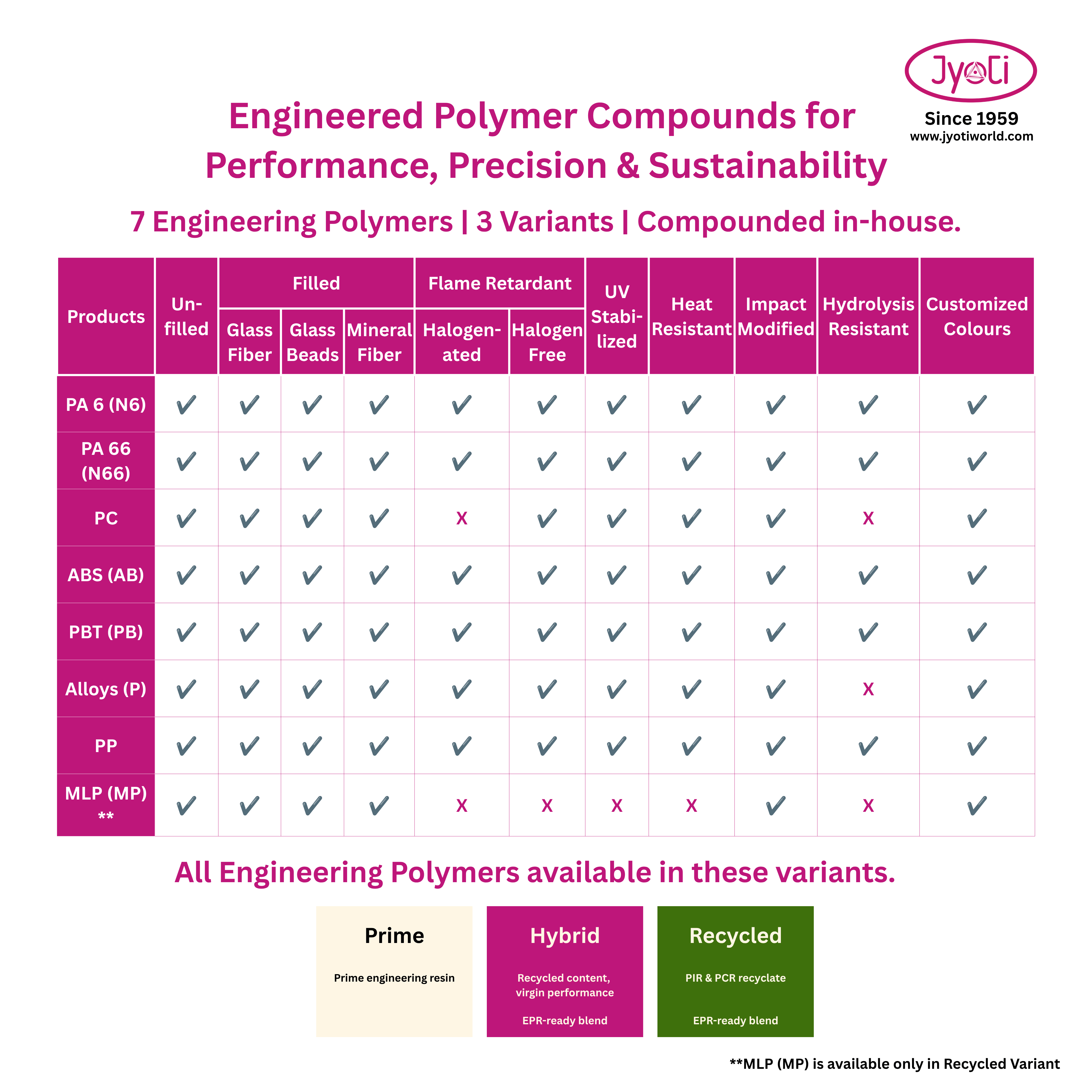
Polymer Compounds
Jyoti World highlights polymer compounding using Virgin, Hybrid, Prime, PIR and PCR materials to balance performance, consistency and sustainability.
MUMBAI, MAHARASHTRA, INDIA, August 20, 2026 /EINPresswire.com/ -- Jyoti World Private Limited is strengthening its polymer compounding offering across three material platforms - Virgin, Hybrid, and Recycled as manufacturers increasingly seek to balance application performance, material consistency, sustainability goals, and material economics.
Dr Atul Raja, Vice President – Engineering Plastics (Compounding), Jyoti World Private Limited, emphasized that the three platforms should be assessed not merely on cost but on the quality and performance of the end product. He highlighted that achieving optimum product quality requires careful selection and proper balancing of resin proportions within the formulation.
Three Material Platforms for Different Requirements:
Virgin grades are based predominantly on virgin polymer resins and are recommended for applications where defined performance characteristics, superior quality, product criticality, consistency, and stringent specification compliance are essential. Their controlled formulation ensures predictable processing behavior and dependable end-use performance.
Hybrid grades combine virgin and recycled polymer content through a controlled formulation. They let manufacturers incorporate recycled content while maintaining material consistency and application-appropriate performance.
Recycled grades are increasingly being adopted to meet sustainability goals and market expectations. These materials are predominantly formulated using Post-Industrial Recycled (PIR) and/or Post-Consumer Recycled (PCR) polymers. The performance of recycled grades depends significantly on the quality, source, consistency, and proportion of the recycled material used. Careful evaluation of these factors is essential when considering recycled grades as substitutes for virgin or hybrid materials in selected applications where performance requirements can be met.
Jyoti World's compounding portfolio spans polymer families including PA6, PA66, Polycarbonate, ABS, PBT and Alloy/Blend compounds, with formulations incorporating reinforcement and performance modifications such as glass fiber, mineral fillers, talc, glass beads, flame retardancy, UV stabilization, impact modification and lubrication.
Material Selection Begins With the Application:
The company advocates an application-led approach to selecting between Virgin, Hybrid and Recycled compounds.
Performance requirements such as impact strength, torque, stiffness, dimensional stability, thermal behavior, and processing characteristics must be considered alongside recycled-content objectives and overall material economics.
For applications where mechanical consistency is particularly important, Hybrid grades can balance recycled content with virgin polymer through controlled formulation.
From PIR and PCR to Sustainable Engineered Compounds:
At Jyoti World, we develop sustainable compounded grades using carefully selected combinations of Prime, PIR (Post-Industrial Recycled), and PCR (Post-Consumer Recycled) materials. The formulation strategy is designed around the type, source, and quality of available recycled material.
Neither PIR nor PCR alone can necessarily meet all performance requirements for recycled or hybrid compounds. An optimum combination of Prime, PIR and PCR materials may therefore be required to achieve the desired balance of mechanical properties, processability, appearance, consistency and cost.
A key success factor in developing sustainable compounds is the ability to source PIR and PCR materials of consistent quality. Variations in recycled feedstock can significantly influence the final properties of compounded grades. Supplier qualification, traceability and quality control of recycled raw materials therefore play an important role in maintaining product consistency.
With the right formulation and raw material sourcing strategy, Jyoti World can develop sustainable compounded grades for demanding applications across sectors including Automotive, Electrical & Electronics, Consumer Goods and Industrial Products. For automotive applications, Jyoti World's offering focuses specifically on polymer compounds, rather than its broader plastics manufacturing capabilities.
The company focuses on providing environmentally responsible material solutions while maintaining the performance, reliability, and consistency customers expect.
Integrated Material-to-Compound Capability:
Polymer compounding involves more than combining different materials. Formulation, reinforcement, additives, processing conditions, and quality control all influence the properties and consistency of the final compound.
Jyoti World's Custom Compounding Unit develops and produces engineered polymer compounds using co-rotating twin-screw compounding technology, supported by an in-house Material Characterization Lab.
The laboratory enables Jyoti World to evaluate material properties and develop compounds against defined application requirements. Its testing and characterization capabilities support material consistency and formulation development, including compounds intended to meet applicable RoHS and REACH requirements.
Jyoti World currently does not provide independent RoHS or REACH certification. Instead, its material development and characterization capabilities support the formulation and quality requirements associated with these standards.
The company's approach is centered on converting PIR and PCR feedstock into engineered material solutions through appropriate formulation, material selection, and quality control. By balancing recycled content with performance requirements, Jyoti World aims to develop sustainable compounds that deliver the reliability and consistency expected in demanding applications.
This approach reflects a broader principle in sustainable polymer engineering: recycled content should be considered alongside material quality, formulation, processing behavior and end-use performance rather than as a standalone measure of material suitability.
About Jyoti World Private Limited:
Founded in 1959, Jyoti World Private Limited is an Indian plastics manufacturing company providing integrated polymer compounding and plastics manufacturing solutions. Its capabilities include custom polymer compounding, injection molding, profile extrusion, plastic machining, tooling, and value-added manufacturing. The company combines material development with downstream plastics processing to support OEM and industrial applications.
Poorwal Oak
Jyoti World Private Limited
+91 84228 69122
email us here
Visit us on social media:
LinkedIn
YouTube
Facebook
Legal Disclaimer:
EIN Presswire provides this news content "as is" without warranty of any kind. We do not accept any responsibility or liability for the accuracy, content, images, videos, licenses, completeness, legality, or reliability of the information contained in this article. If you have any complaints or copyright issues related to this article, kindly contact the author above.
